Sleep is a little bit like landing a plane.
You can’t be cruising at full speed one minute and safely on the ground the next. There needs to be a gradual descent.
Yet that’s often exactly what we ask our bodies and brains to do at bedtime. We finish work, tidy the house, answer messages, watch television or scroll on our phones and then expect ourselves to get into bed and immediately fall asleep.
A short bedtime yoga practice can help create a little more space between the activity of the day and sleep.
And it really doesn’t need to be long.
This simple 10–12 minute bedtime yoga routine combines three things that work particularly well together:
Move to unwind → Breathe to settle → Rest the mind
You don’t need to work hard or stretch as deeply as possible. In fact, the aim is almost the opposite.
By the end of the practice, you simply want to feel a little quieter than when you started.
Part 1: Move to unwind - around 6 minutes
Stress isn’t something we only experience in our heads.
When the body is in a more alert or stressed state, we can hold tension through the muscles too - perhaps without even noticing it until we finally stop at the end of the day.
Sitting for long periods can also leave the hips and hamstrings feeling tight, while walking, exercising or simply being on your feet can create its own aches and stiffness.
So the first part of this routine is about gently moving through some of the key muscle groups before asking the body to become still.
1. Cat–Cow - 1 minute
Come onto your hands and knees.
As you inhale, gently lift your chest and tailbone and allow the front of the body to open.
As you exhale, round through the spine and let your head soften.
Continue slowly for around a minute, letting your breath determine the pace rather than trying to make the movements as large as possible.
Think of this as your transition out of the day: moving, breathing and beginning to pay attention to how your body actually feels.

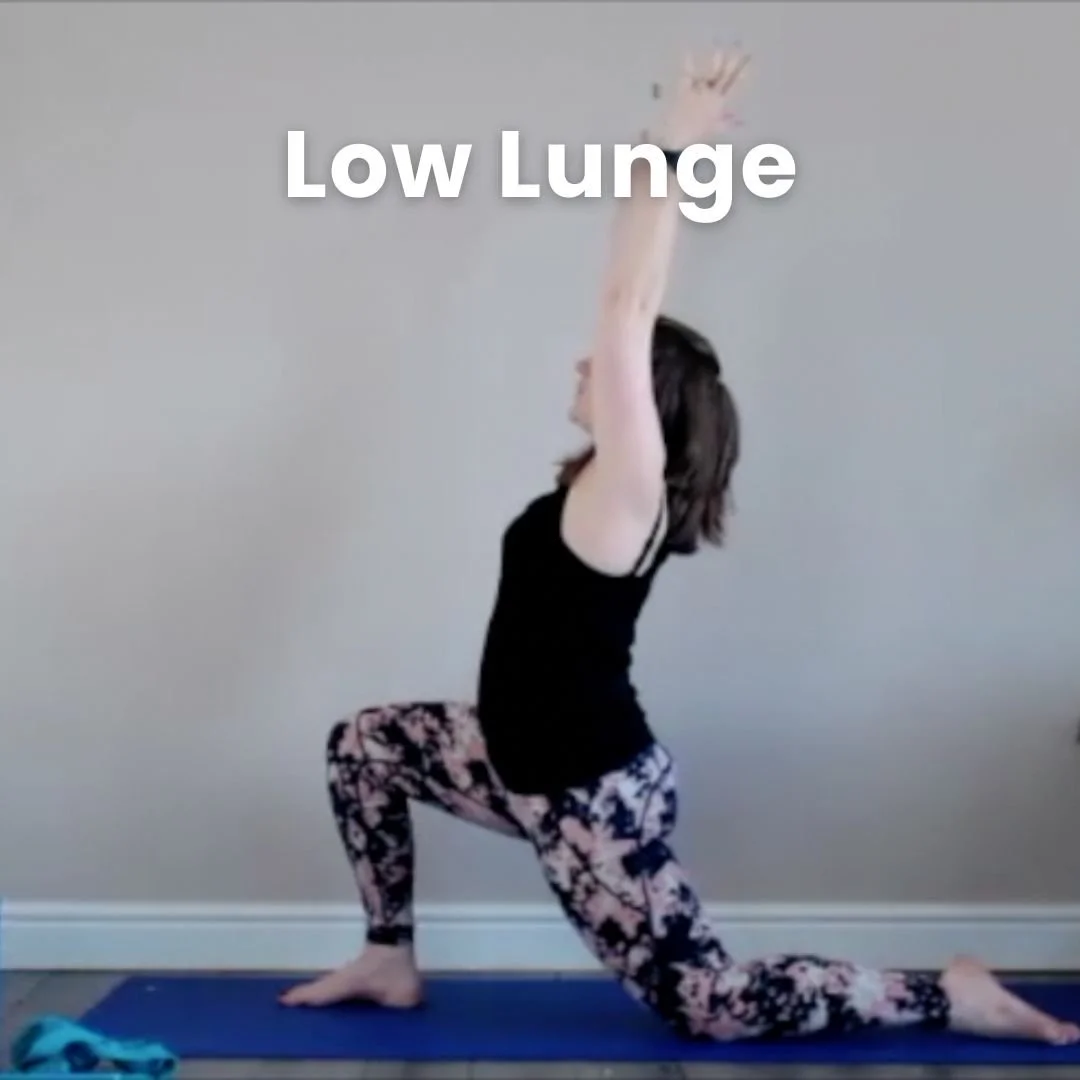
2. Low Lunge - 45 seconds each side
Step one foot forwards between your hands and lower your back knee to the floor.
Bring your hands onto your front thigh or keep them supported on the floor or yoga blocks.
Rather than pushing deeply forwards, gently lengthen through the front of the back hip.
After a day spent sitting, the hip flexors can often benefit from a little space here.
Stay for several slow breaths before changing sides.
3. Half Split - 45 seconds each side
From your low lunge, shift your hips backwards and begin to straighten the front leg.
Keep a small bend in the knee if that feels better and allow your upper body to fold forwards only as far as is comfortable.
You should feel a gentle stretch through the hamstrings at the back of the thigh, rather than trying to reach your head towards your leg.
Again, stay for a few slow breaths before changing sides.
4. Reclined Figure Four / Pigeon Pose - 45 seconds each side
Come down onto your back with both knees bent.
Cross your right ankle over your left thigh, creating a figure-four shape with the legs.
You can stay here or draw the left leg gently towards you.
This targets the glutes and outer hips, which can carry plenty of tension after sitting, walking or exercising.
Let your shoulders and head remain heavy on the floor and resist the temptation to pull the legs towards you too strongly.
Change sides after several breaths.

5. Reclined Twist - around 1 minute
Finish the movement portion lying on your back.
Draw your knees in towards you and allow them to fall gently towards one side. Let your arms rest out to the sides and turn your head wherever feels comfortable.
Take a few slow breaths before bringing the knees through centre and changing sides.
Then return to the middle and allow your whole body to become heavy.
The movement part of your practice is finished.
Part 2: Breathe to settle - around 2 minutes
Now that the body is still, turn your attention towards your breathing.
Start by simply noticing it.
There’s no need to immediately take enormous deep breaths or control anything.
Notice the inhale.
Notice the exhale.
After a few breaths, you might begin to make the exhale slightly longer.
For example:
Inhale for 4.
Exhale for 6.
If those counts don’t feel comfortable, make them shorter. You could breathe in for 3 and out for 4, or simply allow the exhale to feel a little slower than the inhale without counting at all.
The breath should remain easy and relaxed.
Continue for around two minutes.
Think of this as changing gears. You’re no longer asking your body to move; you’re beginning to give it permission to settle.
Part 3: Rest the mind - around 3 minutes
Finally, allow your breathing to return to its natural rhythm.
You can stay lying on your mat, or this is a great point to get into bed.
Now slowly move your attention through your body.
Notice your feet.
Your lower legs.
Your thighs.
Your hips and pelvis.
Your belly.
Your hands.
Your arms.
Your shoulders.
Your jaw.
The muscles around your eyes.
You don’t have to deliberately make each part relax.
Instead, notice its weight and allow the surface beneath you to support it.
If your mind wanders back towards tomorrow, your to-do list or something that happened earlier in the day, that’s fine.
Simply bring your attention back to the next part of the body.
Once you’ve reached your face, spend a few moments noticing your whole body resting at once.
Nothing else to do.
Nowhere else you need to be.
What if you only have five minutes?
Do five minutes.
Your bedtime routine doesn’t need to become another item on your to-do list.
Choose one stretch that feels particularly useful that evening, spend a minute or two slowing your breathing and finish with a short body scan.
A simple practice that you actually repeat is far more useful than an elaborate bedtime routine you rarely have time for.
Bedtime yoga should feel different
It’s worth remembering that yoga doesn’t always need to make you sleepy.
A morning practice might deliberately use bigger movements, stronger poses and a more energising pace to help you wake up.
At bedtime, the intention is different.
You’re not trying to improve your flexibility, squeeze in a workout or achieve a particular pose.
You’re creating a gradual transition from doing to resting.
Think back to that plane coming in to land.
You can’t force yourself to fall asleep on demand. But you can make the descent a little smoother.
Move to unwind.
Breathe to settle.
Rest the mind.
Then let sleep take care of the landing.
Want to explore bedtime yoga with me?
Throughout November, we’re exploring Bedtime Yoga at Worker Bee Yoga, using gentle movement, calming breathwork and meditation to help you create your own toolkit for winding down at the end of the day.
If you’d like some guidance putting these practices together, you can join me for the Bedtime Yoga Challenge and start building a bedtime practice that works for you.